Personal preference is a big factor here, but here are some of my thoughts. See my Gear page for related comments, my clothing list, and supplier listings.
New Zealand Conditions
Weight is a big issue on a long hike and you may wish to swap your usual hiking clothes for lighter ones. But consider also New Zealand conditions, and especially the South Island, where the Te Araroa Trail is more rugged than the North Island section. If you come from overseas you will notice New Zealanders tend to wear heavy boots, gaiters, shorts over longjohns, heavy Gore-tex rain gear and sturdy packs. There is a reason for this. As noted in the Weather & Hazards pages, New Zealand has a rainy, windy and very changeable climate. Rainstorms with freezing winds can blow though at any time of year, making walking on high ridges life threatening, and bush tracks a sea of mud. Sharp scree can shred lightweight footwear. Dense bush can tear at packs and other gear, especially the sharp thorns of the aptly named bush lawyer vine, and in non-forested country there is the spiny matagouri shrub. The rough conditions of hiking in NZ are suggested by the use of terms like ‘track’ rather than ‘trail’, ‘tramping’ instead of ‘hiking’ and bush (in the sense of jungle) rather than ‘forest’. However, you do need to save weight. So a compromise has to be reached where you accept that your gear might get trashed, you will be less comfortable wearing or using it, and safety will need informed judgement, but your pack is lighter.
Rain Gear
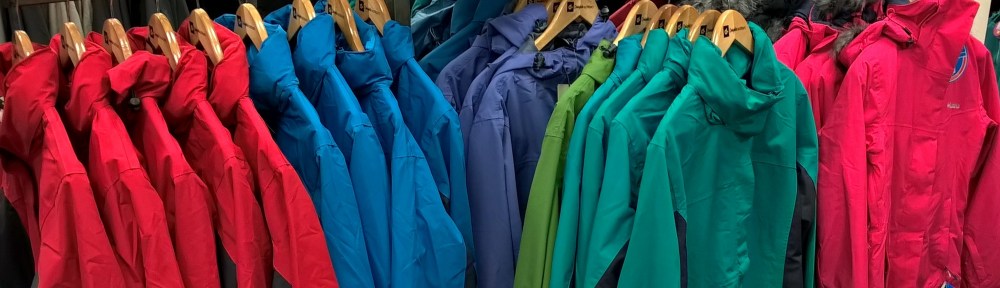
Not only can it be rainy and windy in NZ, but chances are you will experience both conditions simultaneously (along with cold temperatures). There’s nothing like a long length Gortex or similar fabric parka for keeping you warm, comfortable and dry in these situations. The sort that extend well down the thigh are available at Macpac (as the Resolution XPD, 660g), and Earth Sea and Sky (Hydrophobia, 750g). These sorts of parka could literally save your life in really severe conditions. However, they are heavy, so you need to make a call on that. By contrast, the ultralight Outdoor Research Helium II (200g), a long-running standard amongst lightweight rain jackets, might keep you dry up to a point, but not warm, and doesn’t go much below the waist. In a storm you would probably wish you had a heavier jacket, but you could always just avoid this sort of test by checking weather forecasts frequently and not venturing out when it is going to be cold, windy and raining heavily. An even lighter jacket than the Helium is ZPacks’ Vertice at 152g. And you can always look at running jackets for weight savings. They are good for wind resistance and breathability, and when you are hiking the latter is important, as you can end up wetter inside a rain jacket than outside due to sweating, but don’t expect a high standard of waterproofness. My Kathmandu Zeolite does well on both scores, but they don’t make them anymore. Sigh!
Somewhat heavier, but still reasonably light is the Marmot Precip. This has been sold for over 20 years now and is a classic. It is modestly priced (around $200 in NZ) and weighs 305g. Its fabric is not incredibly breathable, but it does have zipped vents at the armpits, something few other parkas do and which can take out a lot of moisture.
For rain pants the OR Helium (201g) is again a standard in the light weight department, but the Macpac Nazomi is lighter at 160g and has published ratings on waterproofness and breathability (both respectable). The ZPacks Vertice rainpaints weigh in at an unbelievable 72g, but they have no leg zippers, so you have to take your shoes off whenever you put them on or off.
Tops
It is worth always having a spare that will be dry to put on in the hut or at camp, and clean enough to sleep in. Many people choose merino wool for tops these days, though they are expensive, even in the land of sheep. Merino does have the great advantage of not smelling after days of wear, and it is warm when wet (including simply with sweat). But it can be heavier than synthetic material, and personally I find it scratchy on the skin (no matter how fine and regardless of itch-free claims) as well as suffocating when hot. However, a synthetic fibre blended in can make all the difference, though it can be hard to find such garments. Macpac, Kathmandu and even Icebreaker have all made blends, but their commitment to continued production on each model has been shaky. I carry a merino blend T-shirt for cooler days and walking in the bush, and a lightweight, loose fitting, long-sleeved shirt with a fold-up collar for hiking in the open on sunny days. Plus some warm tops for cooler temperatures when I’ve stopped generating heat by walking – at camp, in huts, in towns.
Consider brightly coloured clothing. You will probably be spending a fair bit of time road walking (or hitch hiking) and being seen could be a lifesaver. When you think of the other life saving advantages – being spotted if a search party is looking for you and lessening the chance of being shot by an incompetent hunter – you wonder why so little outdoors gear is brightly coloured. (Well, I do know the answer: because it is mostly bought for urban wear).
The official TA notes often say you should wear a high-vis vest when road walking, but this is an inadequate solution. First, you are wearing a pack, so no-one will see your vest from behind. Second, vests tend not to cover the front so well. And third they can be relatively heavy. Solutions are to wear such a vest reversed, so the back is at the front; use a high-vis pack cover; or wear a high-vis runner’s singlet over your usual top. All these carry a bit of a weight penalty, though you might regret trying to save a few grams as you die in pain at the side of the road after being hit by a car. However, I have some solutions. I made a patch of fluoro nylon, backed by Tyvek to give it extra brightness, to attach to the back of my pack. And I sewed a fluoro apron to wear at the front that gives far more coverage than a high-vis vest and is much lighter (23g). I reckon the TA Trust should be selling these potential life-savers rather than logo-emblazoned T-shirts or whatever. 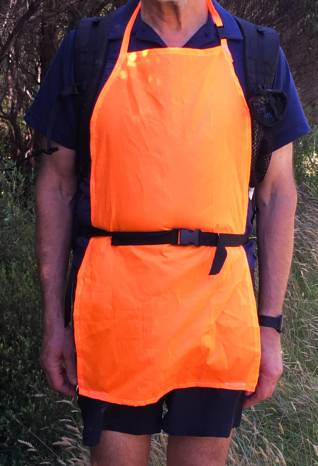
Bottoms
The classic Kiwi tramping outfit is shorts over longjohns and a longjohn top. It gives you freedom of movement, keeps you warm, and is reasonably comfortable to walk in when it’s raining. Many overseas hikers seem to wear long pants however. I’m not clear why this is (protection against ticks, which are not an issue in NZ?), but I don’t think they are a good idea in NZ conditions. They can be hot to walk in, get muddy or torn easily, and are very unpleasant to wear when wet. A few minutes walking through wet tussock or ferns will leave your trousers soaking.
However, long pants are nice to wear around camp (especially when windy or cold), keep off the sandflies, prevent sunburn, and are handy for looking respectable in town. I like to take some super light ones. Leggings (tights) are always an alternative.
Skirts or kilts are something to consider. Cool and not sweaty around the nether regions, no chafing, easy to dry. But they are not so good in windy conditions. Both Macpac and Kathmandu sell a ‘skort’, which is essentially a skirt over tight shorts, which solves the wind issue but doesn’t make them cool to wear. A rain skirt sounds like a great alternative to waterproof trousers, but alas, in New Zealand chances are that if it is raining it will be windy and the skirt will be flapping around and blowing upwards all the time.
It’s worth looking for zipped pockets in shorts. There is nothing more annoying than your sunglasses, reading glasses, map, track guides, etc., slipping out of your pocket when you sit down. You don’t want to carry too much in them because that’s just annoying too, but there are always things you want to have at hand (scroggin and cellphone in addition to the above) and hip pockets on packs usually have limited capacity, or are non-existent in some cases.
For underwear, consider merino for its non-stinky properties. Macpac sell some great women’s briefs that are potentially fine for either sex.
Accessories
You will need a hat or two: a sun hat and a warm hat. Remember the wind: a wide brimmed sun hat is great for protection, but flaps around in the wind. And even a beanie can be whipped off your head in the wind. I would definitely choose head wear that has a neck tie.
For the hands, consider sun gloves. Do you want to end up in old age with wrinkly hands covered in sun spots? You can also get arm protectors. The OR ones are quite heavy (you might as well just have a long sleeve shirt) but the Macpac ones are very light. A good hat, gloves, and arm and leg protection all save you carrying suncream and wearing a sticky layer on your skin that just gets dirty and is hard to wash off. You should ideally carry warm gloves for bad days on mountain tops. And waterproof covers for when it rains, as it is the windchill that will freeze wet fingers. You might be able to economise with breadbags and rubber bands for such days though.
Feet and Legs
It’s good to carry a clean pair of socks you can always rely on to sleep in. And to be dry to wear in the hut. There are a lot of stream crossings on the trail, so you will often finish your day with wet socks. There are waterproof socks, but they are expensive. I’ve been trying some for a while, and they are wonderful when your shoes are wet on the inside, but it you get water inside the socks (if you wade through a stream that is deeper than the top of the socks for instance), then it takes a long time to dry them out. They also seem to get wet inside after walking in the rain or crossing streams and rivers several days running, so maybe they are not right for the TA. But I do recommend a light-weight inner pair of socks, as these can help prevent blisters, as can socks with toes, such as those made by Ininji or Barefootinc. Plus they can double as a spare set of easily dried socks.
Gaiters keep twigs and stones out of your shoes/boots, bidi-bids and other hooked seeds off your socks and legs, protect your legs from abrasions, stop dust on country roads from making your legs and socks filthy, or mud in the bush doing likewise, as well as help keep your feet dry. With gaiters you can cross many a stream without water getting into your boots if you scamper across quickly enough. As noted above, they are popular with serious NZ trampers, but less commonly worn by people on the TA. But you don’t have to wear the heavy, knee-high version. There are the sort made for trail runners that cover just the ankles. They are less robust and are arguably more of a hassle to put on and take off, because they don’t pull apart, but they are light weight.
Footwear
The big question is whether to go for full tramping boots or trail runners. The latter are popular for through-hiking in the USA and are pretty much taking over the TA too now. There is an old adage dating back to the 1953 Mt Everest expedition that each kg on your feet is equivalent to 5 kg in your pack in terms of energy requirement on you. Research has backed this up, though the relationship is influenced by speed, incline and other factors. So saving weight on your feet means you can travel further. Boots are said to give more ankle support, which becomes increasingly important the more you are carrying on your back, as this makes you unstable – but you should be carrying a light load. They are usually far more durable than trail runners (an important consideration in NZ’s rough conditions, especially when it comes to scree slopes), and more waterproof. Trail runner fans argue that waterproof claims for boots are largely fiction, and if you get your trail runners wet they soon dry, unlike boots. As for durability, well you just buy a new pair when they wear out. And note that they probably will wear out and you will need to buy a new pair at some point on the trail. But once you are north of Wanaka on the TA South Island you will have to go well off-trail (to Christchurch probably) to buy replacements, and what happens if the sole simply comes apart when you are miles from anywhere?
I bought some Keen Targhee Mid boots as a compromise between the two camps. Their toe box room is fantastic and they are a relatively light weight boot. But half way up the South Island I was seriously worrying whether they would last the distance and at the end they were only suitable for the rubbish bin. Claims of waterproofness didn’t stack up either. Sure, you might be able to splash through a couple of streams without water coming in, but not half a dozen in a row. Just walking for an hour in long wet grass gave me wet feet. I currently have some Hoka Tor Summit walking shoes. Fantastically comfortable, and claim to be waterproof and breathable, and kept my feet dry splashing through streams and an hour in the rain, but yep, failed the wet grass test. Also, no amount of waterproofing is going to help you much when the stream or river you walk through goes over the ankles.
Consider buying some good insoles for better cushioning and arch support. Most of those that come with shoes or boots – even expensive ones – are rubbish.
And if you have suffered foot pain on previous hikes there is a good chance this will be magnified on a long hike like the TA. See a podiatrist or sports doctor before you buy footwear. Likewise see a physiotherapist or sports doctor if you have had knee pain or other joint and muscle issues. Again, minor complaints in other circumstances can turn into a show stopper on the TA. Before starting the TA I often had mild heel pain, especially just when getting up in the morning, or after a long day, but I never thought much of it. By day 32 on the trail the pain was so severe I was wondering if I could finish the South Island. An internet self-diagnosis suggested plantar fasciitis and I got a friend to send me some heel gels, which helped a bit. Once back home a visit to the podiatrist resulted in orthotics and buying walking shoes (Hokas) with a very stiff shank (sole) and lots of cushioning. Problem solved. I wish I had sorted this before I walked the TA.
Finally, for clothing reviews, including footwear, see Outdoor GearLab, my favourite site, and for shoes and boots, the very thorough RunRepeat site.
Last updated 30 Oct 2025
 Te Araroa Trail - Northbound Guide